

AI with confidential memory
ConfAI · · 4 min read
- AI memory
- Private AI
- Law firms
ChatGPT, Claude and Gemini keep what you tell them on their servers, and after a few months the AI knows more about you than you do. ConfAI offers private AI memory instead: your rules and matters live on your PC, and whatever it uses from them reaches the AI as placeholders.
Where does private AI memory keep what it knows?
With ChatGPT, Claude and Gemini, memory sits on their servers. Over time, the AI ends up knowing more about you than you do: which matters you handle, who your clients are and how you write. All of it is stored on another company's servers.
OpenAI says the ChatGPT memory summary does not necessarily include every detail, and deleting a chat does not necessarily delete a memory created from it.
Google requires Keep Activity for Gemini to remember you. That activity is kept for 18 months by default and helps train its models. Claude turns memory on by default for Free, Pro and Max users, which is the first thing to know if you have Claude privacy concerns.

ConfAI keeps its memory on your PC, available to the AI at all times: your rules, your matters and what it has learned about you. You review it and delete what you don't need, and before any of it reaches the AI, it goes through the same anonymization as your messages.
We tested it with a fictitious collection matter (every name and detail in the example is made up): $18,200 owed on three unpaid invoices. ConfAI swapped 7 details for placeholders, including the client's name, his cell number and the debtor, and saved two rules.
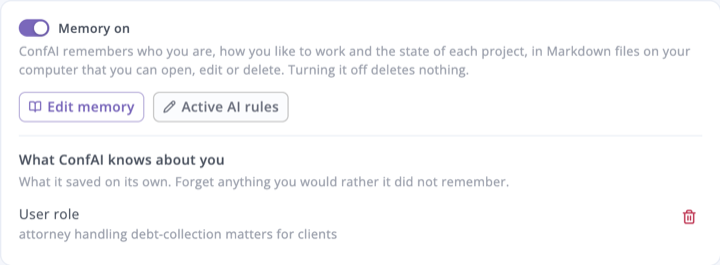
Rules apply in every chat and travel with each request to the AI. To drop one, delete its line and save.
Ask for the client email without restating the matter
Open a new chat in ConfAI and type the request with no names; the anonymization panel then shows where each detail came from. We typed:
"Write my client from the $18,200 invoices claim a short email with the status and the next step. Just the email, no template."
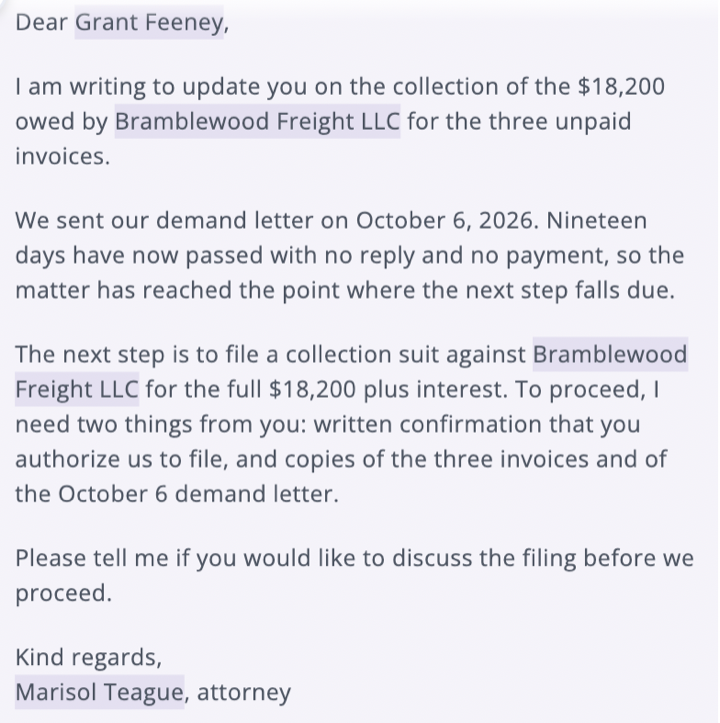
ConfAI pulled the matter from memory, and the AI returned this answer with the real names, signed the way the rule asked:
- Status. I am writing to update you on the collection of the $18,200 owed by Bramblewood Freight LLC for the three unpaid invoices.
- Timeline. We sent our demand letter on October 6, 2026. Nineteen days have now passed with no reply and no payment, so the matter has reached the point where the next step falls due.
- Next step. The next step is to file a collection suit against Bramblewood Freight LLC for the full $18,200 plus interest.
- What I need. To proceed, I need two things from you: written confirmation that you authorize us to file, and copies of the three invoices and of the October 6 demand letter.
Before you send it, check the amount against the three invoices and confirm the filing deadline in your state.
What the AI gets from your memory
In the panel, every detail shows its source: "Memory" for your signature, and the earlier chat for the client, the debtor and his phone. All of it went to the AI as placeholders.
That is the point of a private AI assistant with memory: you decide what it keeps, and the AI works on the matter without knowing who your client is. If you are comparing AI for solo lawyers, check where its memory lives before anything else.